The story of the Buddha’s birth is rich with myth and symbolism.
Twenty-five centuries ago, King Suddhodana ruled a land near the Himalaya Mountains.
One day during a midsummer festival, his wife Queen Maya retired to her quarters to rest, and she fell asleep and dreamed a vivid dream. Four angels carried her high into white mountain peaks and clothed her in flowers. A magnificent white bull elephant bearing a white lotus in its trunk approached Maya and walked around her three times. Then the elephant struck her on the right side with its trunk and vanished into her.
When Maya awoke, she told her husband about the dream. The King summoned 64 Brahmans to come and interpret it. Queen Maya would give birth to a son, the Brahmans said, and if the son did not leave the household he would become a world conqueror. However, if he were to leave the household he would become a Buddha.
When the time for the birth grew near, Queen Maya wished to travel from Kapilavatthu, the King’s capital, to her childhood home, Devadaha, to give birth. With the King’s blessings she left Kapilavatthu on a palanquin carried by a thousand courtiers.
On the way to Devadaha, the procession passed Lumbini Grove, which was full of blossoming trees. Entranced, the Queen asked her courtiers to stop, and she left the palanquin and entered the grove. As she reached up to touch the blossoms, her son was born.
Then the Queen and her son were showered with perfumed blossoms, and two streams of sparkling water poured from the sky to bathe them. And the infant stood, and took seven steps, and proclaimed “I alone am the World-Honored One!”
Then Queen Maya and her son returned to Kapilavatthu. The Queen died seven days later, and the infant prince was nursed and raised by the Queen’s sister Pajapati, also married to King Suddhodana.
***
Aspects of this story may have been borrowed from Hindu texts, such as the account of the birth of Indra from the Rig Veda. The story may also have Hellenic influences. For a time after Alexander the Great conquered central Asia in 334 BCE, there was considerable intermingling of Buddhism with Hellenic art and ideas. There also is speculation that the story of the Buddha’s birth was “improved” after Buddhist traders returned from the Middle East with stories of the birth of Jesus.
There is a jumble of symbols presented in this story. The white elephant was a sacred animal representing fertility and wisdom. The lotus is a common symbol for enlightenment in Buddhist art. A white lotus in particular represents mental and spiritual purity. The baby Buddha’s seven steps evoke seven directions – north, south, east, west, up, down, and here.
In Asia, Buddha’s Birthday is a festive celebration featuring parades with many flowers and floats of white elephants. Figures of the baby Buddha pointing up and down are placed in bowls, and sweet tea is poured over the figures to “wash” the baby.
Newcomers to Buddhism tend to dismiss the Buddha birth myth as so much froth. It sounds like a story about the birth of a god, and the Buddha was not a god. In particular, the declaration “I alone am the World-Honored One” is a bit hard to square with Buddhist teachings on nontheism and anatman.
However, in Mahayana Buddhism it is said the baby Buddha was speaking of the Buddha-nature that is the immutable and eternal nature of all beings. On Buddha’s birthday, some Mahayana Buddhists wish each other happy birthday, because the Buddha’s birthday is everyone’s birthday.
Friday, July 2, 2010
Buddha: Man, Ideal, Symbol
The word Buddha means many things -- a person from Asian history; an ideal of enlightenment; a symbol of wisdom, compassion and absolute reality. Here is an exploration of the many facets of Buddha.
What's a Buddha?
The Buddha is pictured in many ways, and the word Buddha is used to mean many things. Just who or what is a Buddha?
Life of the Buddha
There are no contemporary records that corroborate the Buddha's biography. Historically accurate or not, the life of the Buddha is one of humanity's greatest and most enduring stories. Its themes resonate through the ages, reflecting the deepest fears and hopes within us all.
The Birth of the Buddha
The story of the Buddha’s birth is rich with mythical symbolism.
Parinirvana: How the Historical Buddha Entered Nirvana
At his death, the historical Buddha entered complete Nirvana, also called Parinirvana. This is the story of the Buddha's final days.
The Laughing Buddha
When Westerners think of Buddha, usually they picture the short, fat, bald version, not the austere and serious meditating Buddha. Where did the Laughing Buddha come from?
The Buddha and His Message, Past, Present and Future
A lecture on the Buddha's life and teachings given by by the Ven. Bhikkhu Bodhi at the United Nations.
Life of the Buddha Depicted in Art
The Metropolitan Museum of Art in New York presents an online gallery of art illustrating the life of the Buddha.
What's a Buddha?
The Buddha is pictured in many ways, and the word Buddha is used to mean many things. Just who or what is a Buddha?
Life of the Buddha
There are no contemporary records that corroborate the Buddha's biography. Historically accurate or not, the life of the Buddha is one of humanity's greatest and most enduring stories. Its themes resonate through the ages, reflecting the deepest fears and hopes within us all.
The Birth of the Buddha
The story of the Buddha’s birth is rich with mythical symbolism.
Parinirvana: How the Historical Buddha Entered Nirvana
At his death, the historical Buddha entered complete Nirvana, also called Parinirvana. This is the story of the Buddha's final days.
The Laughing Buddha
When Westerners think of Buddha, usually they picture the short, fat, bald version, not the austere and serious meditating Buddha. Where did the Laughing Buddha come from?
The Buddha and His Message, Past, Present and Future
A lecture on the Buddha's life and teachings given by by the Ven. Bhikkhu Bodhi at the United Nations.
Life of the Buddha Depicted in Art
The Metropolitan Museum of Art in New York presents an online gallery of art illustrating the life of the Buddha.

The Life of the Buddha
Siddhartha Gautama's Early Life
Siddhartha Gautama was born about 583 BCE, in or near what is now Nepal. His father, King Suddhodana, was leader of a large clan called the Shakya. His mother, Queen Maya, died shortly after his birth.
When Prince Siddhartha was a few days old, a holy man prophesied the Prince would be either a great military conqueror or a great spiritual teacher. King Suddhodana preferred the first outcome and prepared his son accordingly. He raised the boy in great luxury and shielded him from knowledge of religion and human suffering. The Prince reached the age of 29 with little experience of the world outside the walls of his opulent palaces.
The Four Passing Sights
One day, overcome with curiosity, Prince Siddhartha asked a charioteer to take him on a series of rides through the countryside. On these journeys he was shocked by the sight of an aged man, then a sick man, and then a corpse. The stark realities of old age, disease, and death seized and sickened the Prince.
Finally, he saw a wandering ascetic. The charioteer explained that the ascetic was one who had renounced the world and sought release from fear of death and suffering.
The Renunciation
For a time the Prince returned to palace life, but he took no pleasure in it. Even the news that his wife Yasodhara had given birth to a son did not please him. The child was called Rahula, which means "fetter."
One night he wandered the palace alone. The luxuries that had once pleased him now seemed grotesque. Musicians and dancing girls had fallen asleep and were sprawled about, snoring and sputtering. Prince Siddhartha reflected on the old age, disease, and death that would overtake them all and turn their bodies to dust.
He realized then that he could no longer be content living the life of a prince. That very night he left the palace, shaved his head, and changed his prince's clothes for a beggar's robe. Then he began his quest for enlightenment.
The Search
Siddhartha began by seeking out renowned teachers, who taught him about the many religious philosophies of his day as well as how to meditate. But after he had learned all they had to teach, his doubts and questions remained. so he and five disciples left to find enlightenment by themselves.
The six companions attempted to find release from suffering through physical discipline--enduring pain, holding their breath, fasting nearly to starvation. Yet Siddhartha was still unsatisfied. It occurred to him that in renouncing pleasure he had grasped pleasure's opposite--pain and self-mortification. Now Siddhartha considered a Middle Way between those two extremes.
He remembered an experience from his childhood, when his mind had settled into a state of deep peace. The path of liberation was through discipline of mind. He realized that instead of starvation, he needed nourishment to build up his strength for the effort. But when he accepted a bowl of rice milk from a young girl, his companions assumed he had given up the quest and abandoned him.
The Enlightenment of the Buddha
Siddhartha sat beneath a sacred fig (Ficus religiosa), known ever after as the Bodhi Tree, and settled into meditation.
The work of Siddhartha's mind came to be mythologized as a great battle with Mara, a demon whose name means "destruction' and who represents the passions that snare and delude us. Mara brought vast armies of monsters to attack Siddhartha, who sat still and untouched. Mara's most beautiful daughter tried to seduce Siddhartha, but this effort also failed.
Finally, Mara claimed the seat of enlightenment rightfully belonged to him. Mara's spiritual accomplishments were greater than Siddhartha's, the demon said. Mara's monstrous soldiers cried out together, "I am his witness!" Mara challenged Siddhartha--who will speak for you?
Then Siddhartha reached out his right hand to touch the earth, and the earth itself roared, "I bear you witness!" Mara disappeared. And as the morning star rose in the sky, Siddhartha Gautama realized enlightenment and became a Buddha.
The Teacher
At first, the Buddha was reluctant to teach, because what he had realized could not be communicated in words. Only through discipline and clarity of mind would delusions fall away and the Great Reality could be directly experienced. Listeners without that direct experience would be stuck in conceptualizations and would surely misunderstand everything he said. But compassion persuaded him to make the attempt.
After his enlightenment, he went to the Deer Park in Isipatana, located in what is now the province of Uttar Pradesh, India. There he found the five companions who had abandoned him, and to them he preached his first sermon. This sermon has been preserved as the Dhammacakkappavattana Sutta and centers on the Four Noble Truths. Instead of teaching doctrines about enlightenment, the Buddha chose to prescribe a path of practice through which people can realize enlightenment for themselves.
The Buddha devoted himself to teaching, attracting hundreds of followers. Eventually he became reconciled with his father, King Suddhodana. His wife, the devoted Yasodhara, became a nun and disciple. Rahula, his son, became a novice monk at the age of 7 and spent the rest of his life with his father.
Last Words
The Buddha tirelessly traveled and taught until his death at age 80. His last words to his followers:
"Behold, O monks, this is my last advice to you. All component things in the world are changeable. They are not lasting. Work hard to gain your own salvation."
Siddhartha Gautama was born about 583 BCE, in or near what is now Nepal. His father, King Suddhodana, was leader of a large clan called the Shakya. His mother, Queen Maya, died shortly
 after his birth.
When Prince Siddhartha was a few days old, a holy man prophesied the Prince would be either a great military conqueror or a great spiritual teacher. King Suddhodana preferred the first outcome and prepared his son accordingly. He raised the boy in great luxury and shielded him from knowledge of religion and human suffering. The Prince reached the age of 29 with little experience of the world outside the walls of his opulent palaces.
The Four Passing Sights
One day, overcome with curiosity, Prince Siddhartha asked a charioteer to take him on a series of rides through the countryside. On these journeys he was shocked by the sight of an aged man, then a sick man, and then a corpse. The stark realities of old age, disease, and death seized and sickened the Prince.
Finally, he saw a wandering ascetic. The charioteer explained that the ascetic was one who had renounced the world and sought release from fear of death and suffering.
The Renunciation
For a time the Prince returned to palace life, but he took no pleasure in it. Even the news that his wife Yasodhara had given birth to a son did not please him. The child was called Rahula, which means "fetter."
One night he wandered the palace alone. The luxuries that had once pleased him now seemed grotesque. Musicians and dancing girls had fallen asleep and were sprawled about, snoring and sputtering. Prince Siddhartha reflected on the old age, disease, and death that would overtake them all and turn their bodies to dust.
He realized then that he could no longer be content living the life of a prince. That very night he left the palace, shaved his head, and changed his prince's clothes for a beggar's robe. Then he began his quest for enlightenment.
The Search
Siddhartha began by seeking out renowned teachers, who taught him about the many religious philosophies of his day as well as how to meditate. But after he had learned all they had to teach, his doubts and questions remained. so he and five disciples left to find enlightenment by themselves.
The six companions attempted to find release from suffering through physical discipline--enduring pain, holding their breath, fasting nearly to starvation. Yet Siddhartha was still unsatisfied. It occurred to him that in renouncing pleasure he had grasped pleasure's opposite--pain and self-mortification. Now Siddhartha considered a Middle Way between those two extremes.
He remembered an experience from his childhood, when his mind had settled into a state of deep peace. The path of liberation was through discipline of mind. He realized that instead of starvation, he needed nourishment to build up his strength for the effort. But when he accepted a bowl of rice milk from a young girl, his companions assumed he had given up the quest and abandoned him.
The Enlightenment of the Buddha
Siddhartha sat beneath a sacred fig (Ficus religiosa), known ever after as the Bodhi Tree, and settled into meditation.
The work of Siddhartha's mind came to be mythologized as a great battle with Mara, a demon whose name means "destruction' and who represents the passions that snare and delude us. Mara brought vast armies of monsters to attack Siddhartha, who sat still and untouched. Mara's most beautiful daughter tried to seduce Siddhartha, but this effort also failed.
Finally, Mara claimed the seat of enlightenment rightfully belonged to him. Mara's spiritual accomplishments were greater than Siddhartha's, the demon said. Mara's monstrous soldiers cried out together, "I am his witness!" Mara challenged Siddhartha--who will speak for you?
Then Siddhartha reached out his right hand to touch the earth, and the earth itself roared, "I bear you witness!" Mara disappeared. And as the morning star rose in the sky, Siddhartha Gautama realized enlightenment and became a Buddha.
The Teacher
At first, the Buddha was reluctant to teach, because what he had realized could not be communicated in words. Only through discipline and clarity of mind would delusions fall away and the Great Reality could be directly experienced. Listeners without that direct experience would be stuck in conceptualizations and would surely misunderstand everything he said. But compassion persuaded him to make the attempt.
After his enlightenment, he went to the Deer Park in Isipatana, located in what is now the province of Uttar Pradesh, India. There he found the five companions who had abandoned him, and to them he preached his first sermon. This sermon has been preserved as the Dhammacakkappavattana Sutta and centers on the Four Noble Truths. Instead of teaching doctrines about enlightenment, the Buddha chose to prescribe a path of practice through which people can realize enlightenment for themselves.
The Buddha devoted himself to teaching, attracting hundreds of followers. Eventually he became reconciled with his father, King Suddhodana. His wife, the devoted Yasodhara, became a nun and disciple. Rahula, his son, became a novice monk at the age of 7 and spent the rest of his life with his father.
Last Words
The Buddha tirelessly traveled and taught until his death at age 80. His last words to his followers:
"Behold, O monks, this is my last advice to you. All component things in the world are changeable. They are not lasting. Work hard to gain your own salvation."
What is the Buddha?


Buddha is a Sanskrit word that means "awakened one." A Buddha is someone who has realized the enlightenment that ends the cycle of birth and death and which brings liberation from suffering.
Who's Who?
Is the fat guy Buddha, or is the skinny guy who meditates Buddha? They are both Buddha, but different Buddhas. The fat, laughing Buddha emerged from Chinese folklore in the 10th century. He is called Pu-tai in China and Hotei in Japan, and is said to be an incarnation of the future Buddha, Maitreya.
Future Buddha?
The early Pali texts names six Buddhas who lived before the historical Buddha, and one who will come after, who is Maitreya. Theravada Buddhism teaches that there is only one Buddha per age, and the Buddha of our age is the historical Buddha, the person born Siddhartha Gautama in the 6th century BCE. (In Theravada Buddhism, other people who have realized enlightenment during this age are called Arhats.)
He is also called Gautama (or Gotama) Buddha and the Tathagata (which means "he who is thus gone"). Mahayana Buddhists sometimes call him Shakyamuni Buddha, which means "sage of the Shakya." The Shakya was the historical Buddha's clan. As a rule, when English-speaking Buddhists refer to the Buddha, they are talking about the historical Buddha.
Other Buddhas
So the Buddha pictured as meditating is the historical Buddha? Not always. Mahayana art and literature are populated by a number of other Buddhas.
How Many Buddhas?

How many do you need? Seriously, it's not a fixed number. In Mahayana, Buddha-nature is the true nature of all beings. In a sense, everyone is Buddha. In the Zen monastery where I first studied Buddhism, the monks often pointed to the Buddha on the altar and said, "That's you."
To complicate matters further, the Mahayana doctrine of the Trikaya says that each Buddha has three bodies. These are called the dharmakaya, sambogakaya and nirmanakaya. Very simply, dharmakaya is the body of absolute truth, sambogakaya is the body that experiences the bliss of enlightenment, and nirmanakaya is the body that manifests in the world.
In Mahayana literature, there is an elaborate schema of transcendent and earthly Buddhas that correspond to each other and represent different aspects of the teachings. You will stumble into them in the Mahayana sutras and other writings, so it's good to be aware of who they are. As a rule, however, it's not necessary to know and memorize all the transcendent and earthly Buddhas to practice Mahayana Buddhism.
One exception might be Amitabha, or Amida, who has a special place in the Mahayana school known as Pure Land. Veneration of Amitabha is central to Pure Land Buddhism. This Buddha, who symbolizes mercy and wisdom, is most often pictured seated in a lotus blossom.
All Buddhas Are One
The most important thing to understand about the Trikaya is that the countless Buddhas are, ultimately, one Buddha, and the three bodies are also our own body. A person who has intimately experienced the three bodies and realized the truth of these teachings is called a Buddha.
Historical Buddhist Sites
India Buddhist Historical Sites


Before his death, the Buddha enjoined his followers to make pilgrimages to four sites Lumbini, where he was born; Uruvela (modern Bodh Gaya), the site of his enlightenment; Sarnath, the place of his first sermon; and Kushinara, where he died. Each of these sites may be visited today, and Bodh Gaya remains the most sacred of the four.
After the decline of Indian Buddhism in the 12th century, most Buddhist sites were destroyed or fell into disrepair. In 1891 the Sri Lankan Anagarika Dharmapala founded the Mahabodhi Society, which set out to reclaim Bodh Gaya for Buddhism; this was achieved in 1949. Bodh Gaya today is a busy centre of pilgrimage with monasteries and meditation centres run by Tibetan, Burmese, Thai and Vietnamese communities. Visitors will see a remote descendant of the bodhi tree, the magnificent but greatly restored 7th-century Mahabodhi temple, the Buddha's stone seat (vajra-asana) and a museum of Buddhist and Hindu materials.
• Sarnath (Uttar Pradesh)
The Deer Park at Sarnath just north of Varanasi was the site of the Buddha's first discourse and today contains some of the most impressive Buddhist monuments in India. The beautiful park is dominated by the 5th-century Dhamekh stupa: one of two stupas marking the spot where the Buddha is said to have first taught the Dharma. The remains of smaller stupas, shrines, five monasteries and the lower half of an inscribed Ashokan column are among other monuments to have been excavated since the 19th century.
Sarnath's archeological museum contains the Ashokan column's famous lion capital (emblem of the modern Indian state) and many other important works in stone, including a sublime figure of the teaching Buddha from the Gupta period (5th century). Like Bodh Gaya, Sarnath has a thriving international Buddhist community.
• Sanchi (Madhya Pradesh)
Perhaps the finest and most complete Buddhist monument in India is Sanchi's great stupa with its four magnificent free standing gates (toranas). The vast brick stupa itself dates from around the 3rd century BC, but its carved gates and railings were probably executed two centuries later during the Satavahana dynasty. Sanchi was excavated in the early 19th century, and the restoration of the site by British and French archeologists was initiated in 1912.
Visitors today, like traditional Buddhist worshippers, can circumambulate the stupa in a clockwise direction and contemplate the teeming sculptural forms that fill the gate posts and their lofty architraves. Jataka narratives, hieratic elephants and royal lions, Hindu-Buddhist deities and exquisite female nature spirits crowd every part of the four toranas. The small archeological museum houses excavated sculptures; other important Sanchi pieces are in museums in Delhi, London and Los Angeles.
• Ajanta (Maharashtra)
The wild, crescent-shaped ravine pierced with more than twenty Buddhist cave temples makes this one of India's most spectacular sites. Many genres of early medieval sacred art, from elaborately carved monastic halls, to sculptures and wall paintings, are represented here, and prominent among Ajanta's glories are murals painted in glowing reds, blues and greens. Unique to Indian Buddhist tradition, the paintings, in high Gupta style, furnish a vision of Mahayana generosity: a mingling of human, divine and natural forms in a suspension of warm and life-enhancing interplay.
Most sublime in grace, compassion and serenity is the incomparable figure of Padmapani, the lotus carrying aspect of the bodhisattva Avalokiteshvara (cave 1). Scenes from Jataka narratives adorn the walls of several other monasteries in the complex.
Nepal Buddhist Historical Sites


• Kapilavastu and Lumbini
Siddhartha Gautama, the future Buddha, was born at Lumbini near the Shakyan capital of Kapilavastu in the southern region of Nepal known as the terai. The 5th-century Chinese pilgrim Fa-hsien described Kapilavastu as a "great scene of empty desolation", populated by a few monks, a score or two of families and dangerous animals such as lions and white elephants. Fa-hsien none the less visited well-known sites, including the Shakyan palace, the place where the child bodhisattva's identifying marks were discovered, and, east of the city, the garden of Lumbini where the future Buddha's mother bathed and gave birth. Mounds, stupas and other ruins testified to previous Buddhist institutional prosperity. Buddhist tradition tells that the emperor Ashoka visited Nepal in the 3rd century BC and erected a stupa and an inscribed column at Lumbini. Recent excavations have uncovered evidence of stupas, monastic dwellings and the well-preserved structure of the bathing-pool. The Ashokan column -rediscovered in 1896 but snapped in half by a lightning bolt - may also be seen at Lumbini. Theravada and Tibetan monasteries have been built in the past two decades near Lumbini, re-establishing the site as an important, although geographically remote, devotional centre.
• Svayambhunath and Bodhnath (Kathmandu)
To commemorate his missionary visit, the emperor Ashoka is said to have built innumerable stupas in Nepal. Two surviving examples, much restored, may derive from the Ashokan period. These are the remarkable Svayambhunath and Bodhnath stupas in Kathmandu. Both stupas share unique Nepalese architectural features. Surmounting the conventional dome is a "steeple" raised on thirteen diminishing tiers to symbolize the thirteen Buddhist heavens. Yet more striking is the design of the square base (harmika) from which the tiers rise. The harmika is gilded, and a face gazes with immense eyes of inlaid metal and ivory from each side. One explanation for this unique Nepalese iconography is that the eyes suggest a solar cult expressed on some Hindu temples by "sun-faces". A second idea is that the temple represents the "Primal man" (mahapurusha) of early Hinduism. Buddhist theory would suggest that the eyes are a sign of the "all-seeing" Buddha. Visitors are certainly struck by the way in which the eyes follow them as they move round the stupa precincts.
Sri Lanka Buddhist Historical Sites


Today's Anuradhapura is a huge park containing the ruins of the Great Monastery (Mahavihara) established 250 B.C.E. on the outskirts of the ancient Singhalese capital. Anuradhapura is connected by an eight-mile (1 3km) pilgrim's path to Mihintale where the missionary Mahinda first preached and where an excavated stupa can be visited. Disinterred earlier this century from the jungle growth of more than a millennium, Anuradhapura's stupas, monastic ruins, sculptures, reservoirs, and a descendant of the original bodhi tree, provide an intense experience of ancient Buddhism. Dominating the site are two vast stupas with characteristic Singhalese "bubble domes". The Thuparama, although much restored, is probably the oldest monument in either India or Sri Lanka. The Ruwanweli Dagoba, is also heavily restored, and is clad in the undecorated white plaster which differentiates Singhalese stupa architecture from the more ornate Indian style.
At Anuradhapura a wonderful convergence of the modern and the archaic may be experienced. On May and June full moon days, the festivals of Wesak and Poson celebrate, respectively, the Buddha's birth, enlightenment and parinirvana, and the introduction of Buddhism to Sri Lanka. At such festivals, Anuradhapura is enlivened by hundreds of thousands of devotees. For the modern day visitor, one of the great pleasures is touring Anuradhapura on a rented bicycle.
• Polonnaruwa (northeastern Sri Lanka)
While Anuradhapura evokes the austerity of early Singhalese Buddhism, the later site of Polonnaruwa, wonderfully situated on Lake Topawewa, offers an unparalleled view of medieval Buddhist sculpture and architecture. There the visitor may see the immense recumbent parinirvana Buddha and the 25-foot (7.5m) rock-cut figure of Ananda standing by the head of the Master. There too is the colossal meditating Buddha, and the famous sculptured portrait of the sage-king Parakramabahu overlooking the lake and in contemplation of a manuscript.
Equally dazzling are the early 13th-century monuments situated on the "Great Quadrangle". These include the classically proportioned pyramidal brick stupa (Sat Mahal Pasada), the carved stonework of the "temple of the tooth relic" (not to be confused with the Temple of the Tooth in Kandy) and the waving lotus-stem-shaped columns of the Nissanka Lata Mandapaya.
Just as Anuradhapura was abandoned by the 8th century, Polonnaruwa was finally conquered by the Tamils in the 15th century. The art of Polonnaruwa represents the final flowering of Singhalese Buddhist art, still matchlessly preserved in land-locked jungle.
Thailand Buddhist Historical Sites


Much important early and medieval Thai architecture was ruined in southeast Asian wars, but impressive 19th and 20th century Buddhist temples abound in Thailand, and in many parts of the country there are lovely archeological sites. In Bangkok, the Wat Phra Kaeo temple, built by King Rama 1 (1782-1809) in the precincts of his Grand Palace, is a spectacular monument to the Theravada Buddhist revival initiated in the 19th century. This temple is a centre of Thailand's religious life, symbolizing the close bond between the sangha (religious community) and state, and houses the "Emerald Buddha", a figurine of national importance to modern Thai people.
The southern Thai Ayutthaya period of the 14th to 18th centuries brought an influx of new architectural ideas from Sri Lanka. Perhaps the most beautifully preserved of Thailand's medieval monuments are at the Ayutthaya historical park, north of Bangkok. Of special interest are stupas with characteristic Thai "lotus bud" domes, and temple towers showing the influence both of medieval Khmer design and of "honeycombed" south Indian shikhara towers.
Cambodia Buddhist Historical Sites


After a horrifying period of war, the Hindu temple complex of Angkor Wat and the Buddhist Angkor Thom are again accessible. Angkor Thom was the creation of the Khmer "god-king" Jayavarman VII (1181-1219), who converted to Mahayana following the destruction of Angkor by the Cham (Vietnamese) during his father's reign. Jayavarman's Buddhism seems to have been a revised version of the Brahmanical religion which previous Khmer kings had exploited to deify their own persons. The central deity in Jayavarman's religion was Lokeshvara, "Lord of the Worlds", and rebuilding Angkor Thom on a stupendously grand scale, the king created a "Buddhist" city as a monument to Lokeshvara, who was an aspect of Jayavarman's divine self. This convergence of king and deity is still visible in the portrait masks of Jayavarman carved on the four faces of the Bayon temple towers of Angkor Thorn.
Like Borobudur and many other southeast Asian temples, Angkor Thom was conceived as a model of the Buddhist universe. At the centre of an immense complex of shrines is the great Bayon temple with its cluster of five towers, the tallest of which represents Mount Meru, the cosmic axis. The whole of Angkor was moated with 100 yards (90m) of water and criss-crossed by a brilliantly engineered system of canals: the water motif symbolizing the cosmic ocean and the world's four sacred rivers and - not least - acting as an irrigation system. Much of the power of Angkor Thom emanates from a profusion of hybridized
Hindu-Buddhist iconography, carved in a wild, sweet style on the gates and terraces of Jayavarman's temple-mountain. The god-king's portrait gazing across his shattered domain adds sinister pathos.
Indonesia Buddhist Historical Sites

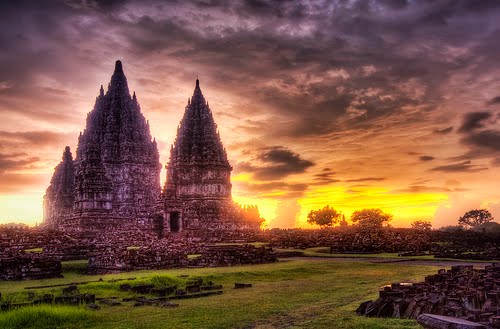
The Borobudur Temple complex is one of the greatest monuments in the world. It is of uncertain age, but thought to have been built between the end of the seventh and beginning of the eighth century A.D. For about a century and a half it was the spiritual centre of Buddhism in Java, then it was lost until its rediscovery in the eighteenth century. The structure, composed of 55,000 square metres of lava-rock is erected on a hill in the form of a stepped-pyramid of six rectangular storeys, three circular terraces and a central stupa forming the summit. The whole structure is in the form of a lotus, the sacred flower of Buddha.
Besides being the highest symbol of Buddhism, the Borobudur stupa is also a replica of the universe. It symbolises the micro-cosmos, which is divided into three levels, in which man's world of desire is influenced by negative impulses; the middle level, the world in which man has control of his negative impulses and uses his positive impulses; the highest level, in which the world of man is no longer bounded by physical and worldly desire. It is ancient devotional practice to circumambulate around the galleries and terraces always turning to the left and keeping the edifice to the right while either chanting or meditating. In total, Borobudur represents the ten levels of a Bodhisattva's life which a person must develop to become a Buddha or an awakened one.
Tibet Buddhist Historical Sites


Visitors may currently enter Tibet from mainland China, Hong Kong or Nepal, if they have a visa for China; the Chinese authorities maintain "closed" areas, but most of the country is accessible. In the holy city of Lhasa, the Dalai Lama's Potala Palace, like many Tibetan monasteries, is now a state museum. Unlike countless shrines and monasteries destroyed during the Cultural Revolution, both the structure and contents of the Potala are preserved. Symbol of the protection of Avalokiteshvara and of the greater Tibetan Buddhist community, the Potala still towers imposingly over Lhasa, and contains countless treasures from the 17th century, including murals, thankas, mandalas, altars, and the famous statue in sandalwood of Padmapani.
The Jokhang monastery, southeast of the Potala, is the most sacred of all Tibetan pilgrimage sites. Somehow surviving the barbarities of the Cultural Revolution, the Jokhang retains its famous gilded roof, and the "Four Deities Radiating Light" may still be seen in their shrine. The Jokhang remains a living monastery; but it may also be visited, like other sacred sites, as a "museum".
China Buddist Historical Sites


Yung-kang is one of the most remarkable Buddhist sites for the massive simplicity of its immense rock-carved Buddhas and the delicate ornamentation of its narrative reliefs. Work on the cave shrines was started by the emperor of the first Wei dynasty in AD 460, in response to persecution of Buddhists over the previous twenty years. In the next decades, in the limestone river cliffs at Lung-men (5th-6th centuries), Wei dynasty monumental carving achieved a spiritual and aesthetic perfection never repeated. The giant Buddhas at Yung-kang recall Indian prototypes; at Lung-men early Buddhist and Mahayana motifs converge in a graceful, serene and authentically Chinese idiom.
Japan Buddhist Historical Sites


Nara, the Japanese imperial capital in the 8th century, remains one of the great centres of East Asian Buddhist history. In and around Nara's historic park are pagodas, early Buddhist and Shinto shrines, formal gardens, the important Nara National Museum, and not least the Todai-ji temple with its immense bronze Buddha statue.
The beauty of old Kyoto lies in its numerous Zen temples dating from the Hieian period, and the famous gardens - "hill gardens" featuring water, and dry gardens featuring rock and sand - of temples such as Tenryuji and Ryoan-ji. Zen is a living tradition and Western students are accepted at some temples in Kyoto as well as in many of the more remote monasteries in the north of the island.
Northern Buddhist Art

The Silk Road transmission of Buddhism to Central Asia, China and ultimately Korea and Japan started in the 1st century CE with a semi-legendary account of an embassy sent to the West by the Chinese Emperor Ming (58-75 AD). However, extensive contacts started in the 2nd century CE, probably as a consequence of the expansion of the Kushan Empire into the Chinese territory of the Tarim Basin, with the missionary efforts of a great number of Central Asian Buddhist monks to Chinese lands. The first missionaries and translators of Buddhists scriptures into Chinese, such as Lokaksema, were either Parthian, Kushan, Sogdian or Kuchean.
Central Asian missionary efforts along the Silk Road were accompanied by a flux of artistic influences, visible in the development of Serindian art from the 2nd through the 11th century AD in the Tarim Basin, modern Xinjiang. Serindian art often derives from the Greco-Buddhist art of the Gandhara district of what is now Pakistan, combining Indian, Greek and Roman influences. Silk Road Greco-Buddhist artistic influences can be found as far as Japan to this day, in architectural motifs, Buddhist imagery, and a select few representations of Japanese gods.
The art of the northern route was also highly influenced by the development of Mahāyāna Buddhism, an inclusive branch of Buddhism characterized by the adoption of new texts, in addition to the traditional āgamas, and a shift in the understanding of Buddhism. Mahāyāna goes beyond the traditional Early Buddhist ideal of the release from suffering (duḥkha) of arhats, and emphasizes the bodhisattva path. The Mahāyāna sutras elevate the Buddha to a transcendent and infinite being, and feature a pantheon of bodhisattvas devoting themselves to the Six Perfections, ultimate knowledge (Prajñāpāramitā), enlightenment, and the liberation of all sentient beings. Northern Buddhist art thus tends to be characterized by a very rich and syncretic Buddhist pantheon, with a multitude of images of the various buddhas, bodhisattvas, and heavenly beings (devas).

Buddha Art Afghanistan style
Although Islamic rule was somewhat tolerant of other religions "of the Book", it showed little tolerance for Buddhism, which was perceived as a religion depending on "idolatry". Human figurative art forms also being prohibited under Islam, Buddhist art suffered numerous attacks, which culminated with the systematic destructions by the Taliban regime. The Buddhas of Bamyan, the sculptures of Hadda, and many of the remaining artifacts at the Afghanistan museum have been destroyed.
The multiple conflicts since the 1980s also have led to a systematic pillage of archaeological sites apparently in the hope of reselling in the international market what artifacts could be found.
 Buddha Art in Central Asia
Thereafter, the expansion of Buddhism to the North led to the formation of Buddhist communities and even Buddhist kingdoms in the oasis of Central Asia. Some Silk Road cities consisted almost entirely of Buddhist stupas and monasteries, and it seems that one of their main objectives was to welcome and service travelers between East and West.
The eastern part of Central Asia (Chinese Turkestan (Tarim Basin, Xinjiang) in particular has revealed an extremely rich Serindian art (wall paintings and reliefs in numerous caves, portable paintings on canvas, sculpture, ritual objects), displaying multiple influences from Indian and Hellenistic cultures. Works of art reminiscent of the Gandharan style, as well as scriptures in the Gandhari script Kharoshti have been found. These influences were rapidly absorbed however by the vigorous Chinese culture, and a strongly Chinese particularism develops from that point.
Buddha Art in China
 Northern Dynasties
A Chinese Northern Wei Buddha Maitreya, 443 AD.
In the 5th to 6th centuries, the Northern Dynasties, developed rather symbolic and abstract modes of representation, with schematic lines. Their style is also said to be solemn and majestic. The lack of corporeality of this art, and its distance from the original Buddhist objective of expressing the pure ideal of enlightenment in an accessible and realistic manner, progressively led to a change towards more naturalism and realism, leading to the expression of Tang Buddhist art.
Sites preserving Northern Wei Dynasty Buddhist sculpture:
* Longmen Grottoes, Henan
* Bingling Temple, Gansu
 Tang Dynasty
Following a transition under the Sui Dynasty, Buddhist sculpture of the Tang evolved towards a markedly life-like expression. Because of the dynasty’s openness to foreign influences, and renewed exchanges with Indian culture due to the numerous travels of Chinese Buddhist monks to India, Tang dynasty Buddhist sculpture assumed a rather classical form, inspired by the Indian art of the Gupta period. During that time, the Tang capital of Chang'an (today's Xi'an) became an important center for Buddhism. From there Buddhism spread to Korea, and Japanese embassies of Kentoshi helped it gain a foothold in Japan.
Tang Bodhisattva.
However, foreign influences came to be negatively perceived in China towards the end of the Tang dynasty. In the year 845, the Tang emperor Wuzong outlawed all "foreign" religions (including Christian Nestorianism, Zoroastrianism and Buddhism) in order to support the indigenous religion, Taoism. He confiscated Buddhist possessions, and forced the faith to go underground, therefore affecting the development of the religion and its arts in China.
Chán Buddhism however, as the origin of Japanese Zen, continued to prosper for some centuries, especially under the Song Dynasty (960-1279), when Chan monasteries were great centers of culture and learning.
 The popularization of Buddhism in China has made the country home to one of the richest collections of Buddhist arts in the world. The Mogao Caves near Dunhuang and the Bingling Temple caves near Yongjing in Gansu province, the Longmen Grottoes near Luoyang in Henan province, the Yungang Grottoes near Datong in Shanxi province, and the Dazu Rock Carvings near Chongqing municipality are among the most important and renowned Buddhist sculptural sites. The Leshan Giant Buddha, carved out of a hillside in the 8th century during the Tang Dynasty and looking down on the confluence of three rivers, is still the largest stone Buddha statue in the world.
Buddha Art in Korea
Korean Buddhist art generally reflects an interaction between Chinese Buddhist influence and a strongly original Korean culture. Additionally, the art of the steppes, particularly Siberian and Scythian influences, are evident in early Korean Buddhist art based on the excavation of artifacts and burial goods such as Silla royal crowns, belt buckles, daggers, and comma-shaped gogok. The style of this indigenous art was geometric, abstract and richly adorned with a characteristic "barbarian" luxury. Although Chinese influence was strong, Korean Buddhist art "bespeaks a sobriety, taste for the right tone, a sense of abstraction but also of colours that curiously enough are in line with contemporary taste" (Pierre Cambon, Arts asiatiques- Guimet').

Three Kingdoms of Korea
Bangasayusang, semi-seated contemplative Maitreya probably from Silla circa early 7th century.
The first of the Three Kingdoms of Korea to officially receive Buddhism was Goguryeo in 372. However, Chinese records and the use of Buddhist motifs in Goguryeo murals indicate the introduction of Buddhism earlier than the official date. The Baekje Kingdom officially recognized Buddhism in 384. The Silla Kingdom, isolated and with no easy sea or land access to China, officially adopted Buddhism in 535 although the foreign religion was known in the kingdom due to the work of Goguryeo monks since the early fifth century. The introduction of Buddhism stimulated the need for artisans to create images for veneration, architects for temples, and the literate for the Buddhist sutras and transformed Korean civilization. Particularly important in the transmission of sophisticated art styles to the Korean kingdoms was the art of the "barbarian" Tuoba, a clan of non-Han Chinese Xianbei people who established the Northern Wei Dynasty in China in 386. The Northern Wei style was particularly influential in the art of the Goguryeo and Baekje. Baekje artisans later transmitted this style along with Southern Dynasty elements and distinct Korean elements to Japan. Korean artisans were highly selective of the styles they incorporated and combined different regional styles together to create a specific Korean Buddhist art style.
 While Goguryeo Buddhist art exhibited vitality and mobility akin with Northern Wei prototypes, the Baekje Kingdom was also in close contact with the Southern Dynasties of China and this close diplomatic contact is exemplified in the gentle and proportional sculpture of the Baekje, epitomized by Baekje sculpture exhibiting the fathomless smile known to art historians as the Baekje smile. The Silla Kingdom also developed a distinctive Buddhist art tradition epitomized by the Bangasayusang, a half-seated contemplative maitreya whose Korean-made twin, the Miroku Bosatsu, was sent to Japan as a proselytizing gift and now resides in the Koryu-ji Temple in Japan. Buddhism in the Three Kingdoms period stimulated massive temple-building projects, such as the Mireuksa Temple in the Baekje Kingdom and the Hwangnyongsa Temple in Silla. Baekje architects were famed for their skill and were instrumental in building the massive nine-story pagoda at Hwangnyongsa and early Buddhist temples in Yamato Japan such as Hoko-ji (Asuka-dera) and Hōryū-ji. Sixth century Korean Buddhist art exhibited the cultural influences of China and India but began to show distinctive indigenous characteristics. These indigenous characteristics can be seen in early Buddhist art in Japan and some early Japanese Buddhist sculpture is now believed to have originated in Korea, particularly from Baekje, or Korean artisans who immigrated to Yamato Japan. Particularly, the semi-seated Maitreya form was adapted into a highly developed Korean style which was transmitted to Japan as evidenced by the Koryu-ji Miroku Bosatsu and the Chugu-ji Siddhartha statues. Although many historians portray Korea as a mere transmitter of Buddhism, the Three Kingdoms, and particularly Baekje, were instrumental as active agents in the introduction and formation of a Buddhist tradition in Japan in 538 or 552.
 Unified Silla
The Goryeo era Gyeongcheonsa Pagoda sits on the first floor of the National Museum of Korea.
During the Unified Silla period, East Asia was particularly stable with China and Korea both enjoying unified governments. Early Unified Silla art combined Silla styles and Baekje styles. Korean Buddhist art was also influenced by new Tang Dynasty styles as evidenced by a new popular Buddhist motif with full-faced Buddha sculptures. Tang China was the cross roads of East, Central, and South Asia and so the Buddhist art of this time period exhibit the so-called international style. State-sponsored Buddhist art flourished during this period, the epitome of which is the Seokguram Grotto.
Goryeo Dynasty
The fall of the Unified Silla Dynasty and the establishment of the Goryeo Dynasty in 918 indicates a new period of Korean Buddhist art. The Goryeo kings also lavishly sponsored Buddhism and Buddhist art flourished, especially Buddhist paintings and illuminated sutras written in gold and silver ink.. The crowning achievement of this period is the carving of approximately 80,000 woodblocks of the Tripitaka Koreana which was done twice.
Joseon Dynasty
The Joseon Dynasty actively suppressed Buddhism beginning in 1406 and Buddhist temples and art production subsequently decline in quality in quantity although beginning in 1549, Buddhist art does continue to be produced
Buddha Art in Japan
 Before the introduction of Buddhism, Japan had already been the seat of various cultural (and artistic) influences, from the abstract linear decorative art of the indigenous Neolithic Jōmon from around 10500 BC to 300 BC, to the art during the Yayoi and Kofun periods, with developments such as Haniwa art.
The Japanese discovered Buddhism in the 6th century when missionary monks travelled to the islands together with numerous scriptures and works of art. The Buddhist religion was adopted by the state in the following century. Being geographically at the end of the Silk Road, Japan was able to preserve many aspects of Buddhism at the very time it was disappearing in India, and being suppressed in Central Asia and China.
Scroll calligraphy of Bodhidharma "Zen points directly to the human heart, see into your nature and become Buddha", by Hakuin Ekaku (1686 to 1769)
From 711, numerous temples and monasteries were built in the capital city of Nara, including a five-story pagoda, the Golden Hall of the Horyuji, and the Kōfuku-ji temple. Countless paintings and sculptures were made, often under governmental sponsorship. Indian, Hellenistic, Chinese and Korean artistic influences blended into an original style characterized by realism and gracefulness. The creation of Japanese Buddhist art was especially rich between the 8th and 13th centuries during the periods of Nara, Heian and Kamakura. Japan developed an extremely rich figurative art for the pantheon of Buddhist deities, sometimes combined with Hindu and Shinto influences. This art can be very varied, creative and bold.

From the 12th and 13th, a further development was Zen art, following the introduction of the faith by Dogen and Eisai upon their return from China. Zen art is mainly characterized by original paintings (such as sumi-e) and poetry (especially haikus), striving to express the true essence of the world through impressionistic and unadorned "non-dualistic" representations. The search for enlightenment "in the moment" also led to the development of other important derivative arts such as the Chanoyu tea ceremony or the Ikebana art of flower arrangement. This evolution went as far as considering almost any human activity as an art with a strong spiritual and aesthetic content, first and foremost in those activities related to combat techniques (martial arts).
Buddhism remains very active in Japan to this day. Still around 80,000 Buddhist temples are preserved. Many of them are in wood and are regularly restored.
Buddha Art In Tibet and Bhutan
 Tantric Buddhism started as a movement in eastern India around the 5th or the 6th century. Many of the practices of Tantric Buddhism are derived from Brahmanism (the usage of mantras, yoga, or the burning of sacrificial offerings). Tantrism became the dominant form of Buddhism in Tibet from the 8th century. Due to its geographical centrality in Asia, Tibetan Buddhist art received influence from Indian, Nepali, Greco-Buddhist and Chinese art.
One of the most characteristic creations of Tibetan Buddhist art are the mandalas, diagrams of a "divine temple" made of a circle enclosing a square, the purpose of which is to help Buddhist devotees focus their attention through meditation and follow the path to the central image of the Buddha. Artistically, Buddhist Gupta art and Hindu art tend to be the two strongest inspirations of Tibetan art.
Buddha Art in Vietnam
Chinese influence was predominant in the north of Vietnam (Tonkin) between the 1st and 9th centuries, and Confucianism and Mahayana Buddhism were prevalent. Overall, the art of Vietnam has been strongly influenced by Chinese Buddhist art.
In the south thrived the former kingdom of Champa (before it was later overtaken by the Vietnamese from the north). Champa had a strongly Indianized art, just as neighboring Cambodia. Many of its statues were characterized by rich body adornments. The capital of the kingdom of Champa was annexed by Vietnam in 1471, and it totally collapsed in the 1720s, while Cham people remain an abundant minority across Southeast Asia.
Thursday, July 1, 2010
Origination of Buddhist Art

Origination of Buddhist Art
Buddhist art originated on the Indian subcontinent following the historical life of Siddhartha Gautama, 6th to 5th century BC, and thereafter evolved by contact with other cultures as it spread throughout Asia and the world.Buddhist art followed believers as the dharma spread, adapted, and evolved in each new host country. It developed to the north through Central Asia and into Eastern Asia to form the Northern branch of Buddhist art, and to the east as far as Southeast Asia to form the Southern branch of Buddhist art. In India, Buddhist art flourished and even influenced the development of Hindu art, until Buddhism nearly disappeared in India around the 10th century due in part to the vigorous expansion of Islam alongside Hinduism.

Buddist art in 5th century - 1st century BCE
During the 2nd to 1st century BCE, sculptures became more explicit, representing episodes of the Buddha’s life and teachings. These took the form of votive tablets or friezes, usually in relation to the decoration of stupas. Although India had a long sculptural tradition and a mastery of rich iconography, the Buddha was never represented in human form, but only through Buddhist symbolism. This period may have been aniconic.This reluctance towards anthropomorphic representations of the Buddha, and the sophisticated development of aniconic symbols to avoid it (even in narrative scene where other human figures would appear), seems to be connected to 70 of the Buddha’s sayings, reported in the Dighanikaya, that disfavored representations of himself after the extinction of his body. This tendency remained as late as the 2nd century CE in the southern parts of India, in the art of the Amaravati school (see: Mara's assault on the Buddha). It has been argued that earlier anthropomorphic representations of the Buddha may have been made of wood and may have perished since then. However, no related archaeological evidence has been found.

Iconic phase (1st century AD – present)
Anthropomorphic representations of the Buddha started to emerge from the 1st century AD in Northern India. The two main centers of creation have been identified as Gandhara in today’s North West Frontier Province, in Pakistan, and the region of Mathura, in central northern India.
The art of Gandhara benefited from centuries of interaction with Greek culture since the conquests of Alexander the Great in 332 BC and the subsequent establishment of the Greco-Bactrian and Indo-Greek Kingdoms, leading to the development of Greco-Buddhist art. Gandharan Buddhist sculpture displays Greek artistic influence, and it has been suggested that the concept of the "man-god" was essentially inspired by Greek mythological culture. Artistically, the Gandharan school of sculpture is said to have contributed wavy hair, drapery covering both shoulders, shoes and sandals, acanthus leaf decorations, etc.
The art of Mathura tends to be based on a strong Indian tradition, exemplified by the anthropomorphic representation of divinities such as the Yaksas, although in a style rather archaic compared to the later representations of the Buddha. The Mathuran school contributed clothes covering the left shoulder of thin muslin, the wheel on the palm, the lotus seat, etc.
Mathura and Gandhara also strongly influenced each other. During their artistic florescence, the two regions were even united politically under the Kushans, both being capitals of the empire. It is still a matter of debate whether the anthropomorphic representations of Buddha was essentially a result of a local evolution of Buddhist art at Mathura, or a consequence of Greek cultural influence in Gandhara through the Greco-Buddhist syncretism.
Representation of the Buddha in the Greco-Buddhist art of Gandhara, 1st century AD.
This iconic art was characterized from the start by a realistic idealism, combining realistic human features, proportions, attitudes and attributes, together with a sense of perfection and serenity reaching to the divine. This expression of the Buddha as both man and God became the iconographic canon for subsequent Buddhist art.
Buddhist art continued to develop in India for a few more centuries. The pink sandstone sculptures of Mathura evolved during the Gupta period (4th to 6th century) to reach a very high fineness of execution and delicacy in the modeling. The art of the Gupta school was extremely influential almost everywhere in the rest of Asia. By the 10th century, Buddhist art creation was dying out in India, as Hinduism and Islam ultimately prevailed.
As Buddhism expanded outside of India from the 1st century AD, its original artistic package blended with other artistic influences, leading to a progressive differentiation among the countries adopting the faith.
* A Northern route was established from the 1st century CE through Central Asia, Tibet, Bhutan, China, Korea, Japan and Vietnam, in which Mahayana Buddhism prevailed.
* A Southern route, where Theravada Buddhism dominated, went through Myanmar, Sri Lanka, Thailand, Cambodia, and Laos.
Subscribe to:
Posts (Atom)